Request a Quote
Send your application, material or reference sample, diameter, length, color, quantity and packaging requirements. We reply within 12 hours.

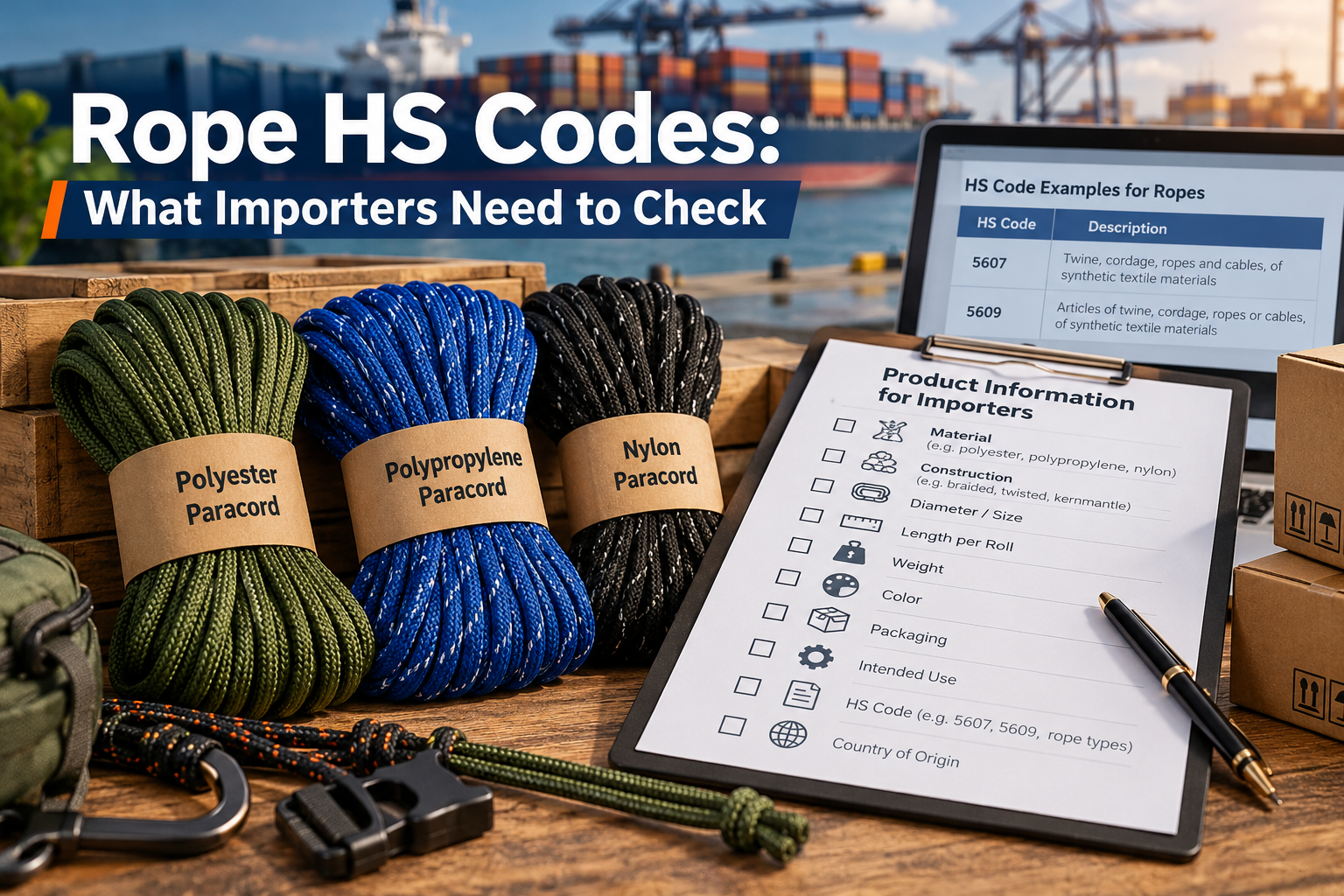
A rope’s classification depends on the product details and the importing country’s tariff schedule. Prepare the composition, construction, dimensions, treatment and assembly information for your customs broker; do not select a code from the material name alone.
Planning a Polyester, Nylon or Polypropylene rope order? Share the application, material, diameter and estimated quantity for review.
“Nylon rope” or “polyester rope” is a starting point, not a customs product description. The same common name can cover products that fall into different subheadings—or even different headings—once construction, treatment, and attached components are considered. A single “rope HS code” cannot be assigned to every rope that shares a fiber name. In practice, a nylon rope HS code, a polypropylene rope HS code, and a polyester rope HS code may each require a separate review against the exact goods.
The international tariff heading for most textile ropes is 5607, which covers twine, cordage, ropes and cables, whether or not plaited or braided, and whether or not impregnated, coated, covered or sheathed with rubber or plastics. Within that heading, subdivisions separate polyethylene and polypropylene from other synthetic fibers, which is one reason a polypropylene rope HS code can differ from a polyester rope HS code at the subheading level. But heading 5607 is not automatic. A product that looks like rope may be classified as an article of yarn, or as a made-up article under heading 5609, depending on how it is constructed and presented.
Construction matters as much as fiber. A tightly plaited cord and a loosely twisted rope can follow different classification paths, so a nylon rope HS code should not be copied from another nylon product without checking the construction. Treatment matters: a rope coated with plastics may still fall within 5607, but the coating must be described accurately. Attached components matter too. A rope sold with a hook, buckle, or clamp is an assembly, and the classification of the assembly may not be the same as the classification of the rope alone.
A historical CBP ruling on satin rattail cord illustrates the point. The question was whether the product was classifiable as twine, cordage, rope or cable under heading 5607, or as a man-made filament yarn under heading 5406. The answer depended on the product’s actual characteristics, not on the word “cord.” Importers should read rulings like this as examples of the questions customs authorities ask, not as ready-made answers for a different product. Do not assign one common rope HS code to every rope. The classification decision starts with the exact goods, not the marketing name.
The Harmonized System (HS) is an international nomenclature maintained by the World Customs Organization. It uses a six-digit structure: the first four digits form the heading, and the fifth and sixth digits identify the subheading. For example, the six-digit level may distinguish polyethylene or polypropylene rope from rope of other synthetic fibers, which is why a polypropylene rope HS code can sit in a different subheading from a nylon rope HS code or a polyester rope HS code at that level. That six-digit structure is the shared international foundation.
Most countries then add national digits beyond six. The United States uses an eight-digit HTS number, and other countries use eight, ten, or more digits to collect duties and statistical data. A rope HS code at the six-digit level is therefore not the same as the code an importer enters on a national entry form. The national tariff code includes destination-specific subdivisions that may reflect duty rates, statistical reporting, or trade program eligibility.
This is why a generic search result is not a reliable classification source. A snippet may show a subheading from an old ruling, a different product, or a different country. The WCO does not provide tariff classification advice to private importers; it directs users to the customs administration of the importing country for the final classification under the relevant national tariff schedule.
The practical rule: use the HS as a map, but verify the destination-specific code in the current official tariff schedule. Do not treat a universal fixed duty rate as part of the HS structure. Duty rates are national, product-specific, and subject to change.
A complete product information sheet reduces back-and-forth with the customs broker and helps avoid a code that does not match the goods. The table below lists the fields an importer should complete for each rope item before requesting a classification decision.
| Field | What to record for the actual order | Why it matters |
| Exact fiber composition | Fiber type or types, with confirmed percentages for the actual order | Different fibers can fall under different subheadings |
| Construction | Braid or twist type; number of strands if twisted; whether hollow, solid, or core-dependent | Construction can affect heading and subheading |
| Diameter and length | Confirmed diameter range and cut length for the shipment | Dimensions support the product description and may affect subheading |
| Treatment or coating | Impregnation, coating, covering, or sheathing, if any, confirmed for the order | Treatment can change the tariff description |
| Attached components | Hooks, buckles, clamps, eye splices, or other end hardware | The assembly may be classified differently from the rope alone |
| Product photos | Clear photos of the rope, the cross-section, and any end finish | Photos confirm construction and components |
| Intended use | The application stated by the buyer or supplier | Use can inform the broker’s analysis but does not override composition |
| Destination | Country of import and, if known, the port or entry program | Classification is destination-specific |
| Manufacturer technical description | The supplier’s written specification for the purchased goods | Customs documents should match the technical reality of the order |
| Packing and commercial documents | Invoice, packing list, and any test or specification sheets | Brokers need consistent documents to support the entry |
Where relevant, add the manufacturer’s technical description and the packing and commercial documents to the same file. Do not leave composition percentages or treatment fields blank if the supplier has confirmed them. Conversely, do not fill them with estimates. A blank field that triggers a follow-up question is safer than a guessed percentage that becomes part of the customs record.
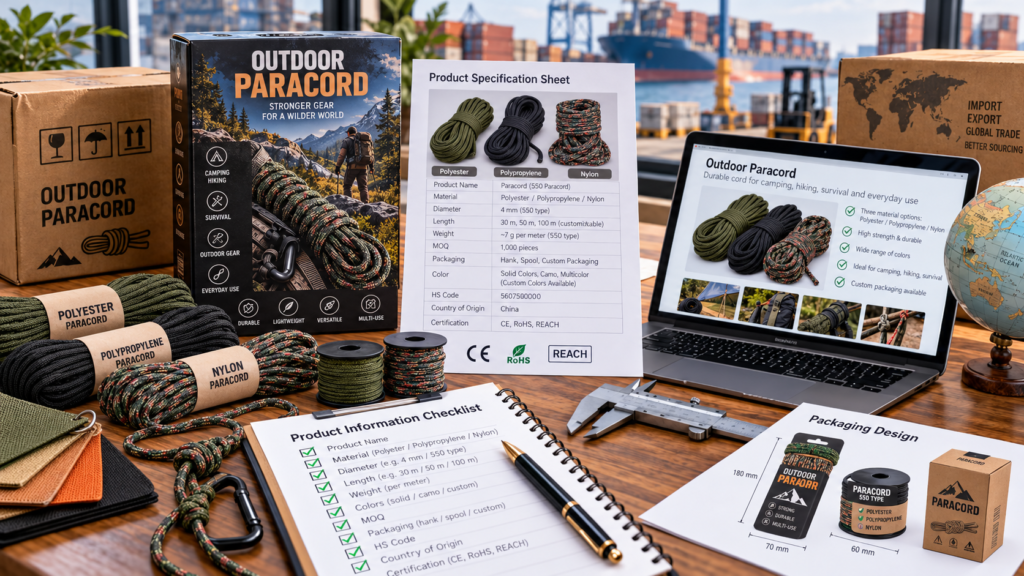
The three example descriptions below use confirmed diameter ranges and construction names from Baiyuheng Ropes, a rope manufacturer in Jiangmen, Guangdong, China. The composition percentages and any treatment details are intentionally left blank so that the actual order information can be inserted before the description is used in a customs document.
Example 1 — Polyester rope. Polyester rope, [confirmed composition percentage to be inserted], [braid or twist construction], diameter range 2–3 mm, [length], [treatment to be confirmed], [end finish to be confirmed]. Baiyuheng confirms Hollow, Solid, Diamond, Double and Flat Braid constructions for polyester rope. Custom length, finishing and packaging must be described for the actual order.
Example 2 — Nylon rope. Nylon rope, [confirmed composition percentage to be inserted], [braid or twist construction], diameter range 4–10 mm, [length], [treatment to be confirmed], [end finish to be confirmed]. Baiyuheng confirms Hollow, Solid, Diamond, Double and Flat Braid constructions for nylon rope. The supplier’s technical description should match the purchased goods.
Example 3 — Polypropylene rope. Polypropylene rope, [confirmed composition percentage to be inserted], [braid or twist construction], diameter range 4–10 mm, [length], [treatment to be confirmed], [end finish to be confirmed]. In addition to Hollow, Solid, Diamond, Double and Flat Braid, Baiyuheng confirms Floating Twisted and 3-Strand Twisted options for polypropylene rope.
If the rope has a hook or buckle, disclose it in the description rather than burying it in a photo. For example: “Polypropylene rope, 4–10 mm, 3-strand twisted, with [hook or buckle type] attached at one end.” The classification effect of that hardware depends on the actual component and the applicable tariff schedule. A CBP ruling on rope clamps and snap hooks classified those items separately under a copper-articles subheading, which shows that hardware can follow a different path from the rope itself. Do not declare a tax effect for the hook or buckle without a verified ruling or a broker’s current analysis for the exact goods.
For buyers sourcing custom lengths, finishes, or OEM configurations, the custom rope and OEM page provides a starting point. End hardware is assessed against the real component or a reference sample, not against a catalog image.
For a United States import, the current Harmonized Tariff Schedule is published by the U.S. International Trade Commission. That schedule shows the legal headings, subheadings, and duty rates for the current revision. An importer should search the current edition for the product description, then confirm the result with a licensed customs broker who can review the actual goods.
CBP’s published rulings are available through the Customs Rulings Online Search System. Rulings illustrate how CBP has analyzed specific products, but they are not universal answers. A ruling on one rope construction, diameter, or assembly does not automatically apply to a different product. The historical cord ruling cited earlier is an example of the reasoning process, not a current classification for a new shipment.
For destinations other than the United States, use the official tariff schedule of the importing country. The WCO’s national contact list can point to the responsible customs administration, but the legal text and the current rate must come from that administration’s official publication.
No numeric code or rate should be inserted into a commercial document without a current official basis for the exact goods. This does not mean classification is impossible. It means the code must be tied to the actual product description and the destination’s current schedule.
Before the commercial invoice and shipping documents are finalized, both sides should close the information gaps for the exact order. The supplier confirms what was actually made and packed. The importer and broker confirm how that product should be declared for the destination.
The manufacturer should put the purchased goods description in writing. This includes the fiber or fiber blend actually used, the construction name, the confirmed diameter and cut length, any coating or treatment, and whether hooks, buckles, clamps, or other end fittings are attached. If the order includes custom finishing or packaging, those details should be stated in the same specification rather than left to a photo. Baiyuheng Ropes, as a manufacturer in Jiangmen, Guangdong, China, should provide this description from the confirmed order record, not from a general catalog page.
The importer or customs broker should then check the destination’s current official tariff schedule and document requirements against that description. If the rope is sold with end hardware, the broker should review the component details separately where needed. The entry file should record the basis for the chosen classification, such as the current official schedule or a ruling that matches the goods. A placeholder can be used internally until that review is complete, but the final entry should not rely on an unverified assumption.
If a treatment is unconfirmed, ask the supplier before the invoice is issued. If the composition percentage is unavailable, do not estimate it. If the broker needs a clearer photo of the end finish or a reference sample for hardware, obtain it before documents are finalized. Replacing a blank field with confirmed order data is better than filling it with a guess that later conflicts with the goods.
This handoff reduces the chance of a mismatch between the product, the invoice description, and the tariff line. It does not guarantee clearance. The customs authority at the destination makes the final classification decision, and the importer remains responsible for the accuracy of the declaration.
Q: Do all Nylon ropes use the same HS code?
A: Do not assume that. The complete product description and the destination’s current tariff schedule must be checked for the exact goods.
Q: Can I use the same tariff code in every country?
A: The HS system provides an international six-digit structure, but countries add subdivisions and apply their own tariff measures. Verify the importing country’s full classification and current requirements.
Q: What information should I send to my customs broker?
A: Provide composition, construction, dimensions, treatment, attached components, photographs, intended use and destination. Ask the manufacturer to clarify any missing technical details.
Q: Does a supplier’s suggested code guarantee clearance?
A: No. A suggested code is not a customs approval. The importer should verify the exact goods and current destination requirements with the appropriate customs authority or broker.