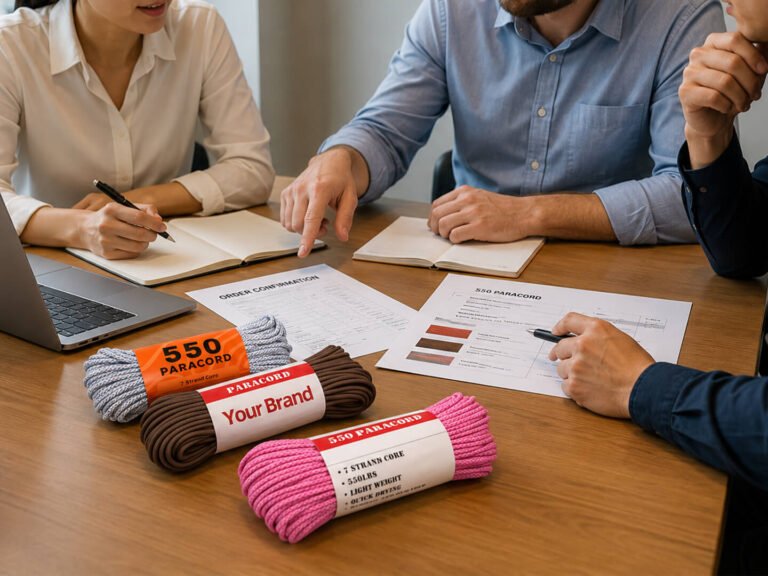
Request a Quote
Send your application, material or reference sample, diameter, length, color, quantity and packaging requirements. We reply within 12 hours.

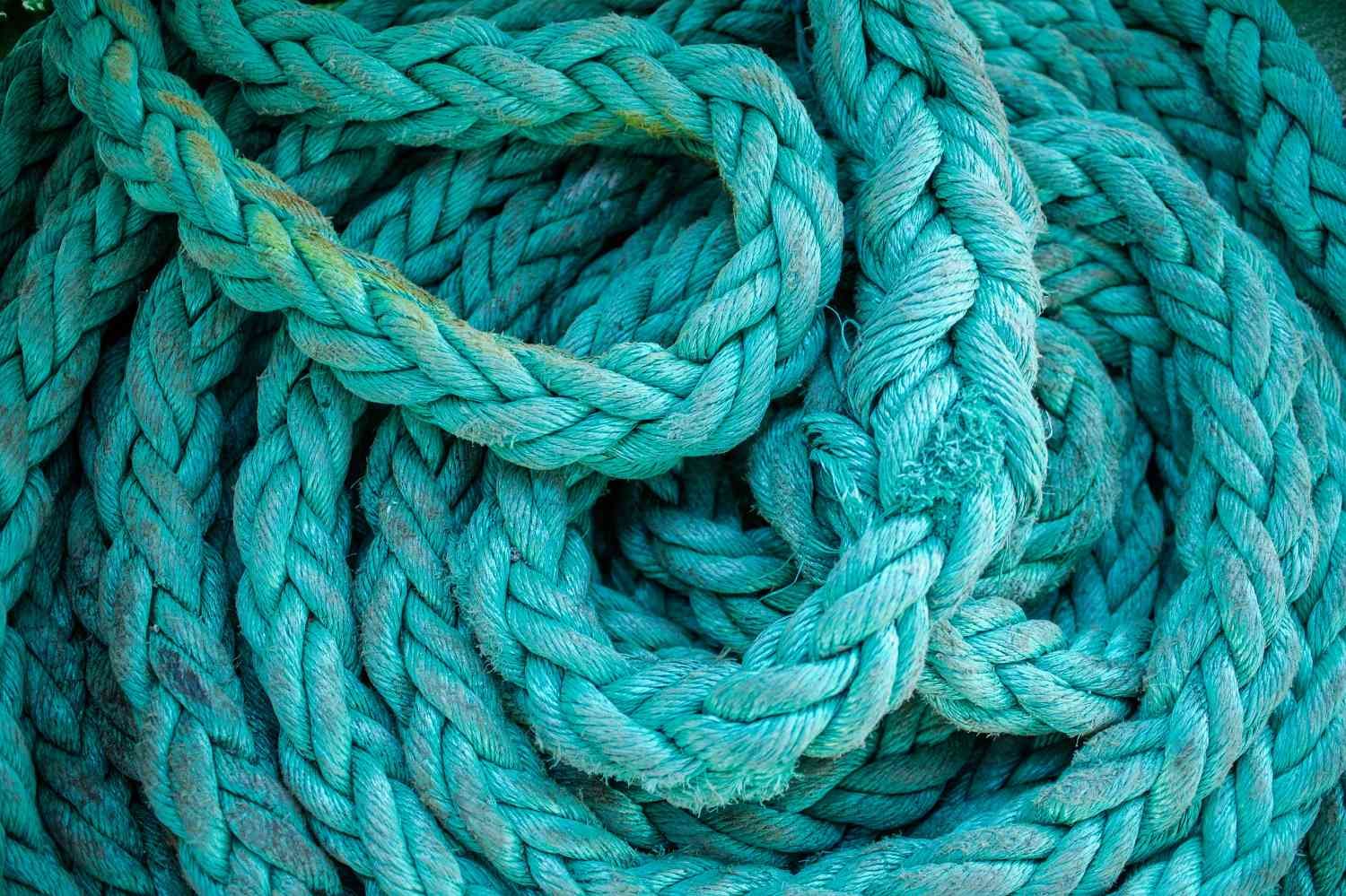
Short answer: custom rope manufacturing can be customized across eight dimensions — material, construction, diameter, colour, length, finishing, packaging, and application-related testing. In practice, that means a buyer specifies the fibre, the braid or twist structure, the exact diameter, the colour and the per-colour order quantity, the cut length and end treatment, any rope-end hardware, the packing format, and any inspection requirement tied to the end use. Everything else — sampling, production planning, and packing — follows from those eight decisions.
This guide is written for procurement managers and product developers who are sourcing rope under their own brand or for their own equipment. It walks through the material options, the braid constructions available across those materials, the diameter and colour programmes, finishing and packaging formats, and the six-step process we follow for OEM rope development. BYH Rope operates its own factory in Jiangmen, China, which means a custom rope & OEM programme runs through one team rather than a chain of traders.
Not sure which rope material fits your job?
Tell us your application and we will point you to the right option.
Rope customization is often treated as a single question — “can you make it in my colour?” — when it is really eight separate decisions. Each one affects the others, which is why experienced buyers work through them in order rather than fixing one and forcing the rest to fit. Here are the eight dimensions, and what each one actually controls.
The fibre determines how the finished rope behaves in the field: whether it stretches, whether it floats, how it feels in the hand, and how it behaves outdoors. Material is the first decision because it narrows everything downstream — construction, diameter range, colour availability, and end-use suitability.
Construction is how the yarns are arranged: braided or twisted, how many strands, and whether the rope is a single braid or a braid over a core. Two ropes made from the same fibre in the same diameter can behave quite differently depending on construction.
Diameter is usually driven by the application, the hardware it must pass through, or the retail size band the product sits in. Available ranges differ by material, so diameter and material should be confirmed together.
Colour covers both stock shades and custom shades. Each material has its own colour programme and its own minimum order quantity per colour, so colour selection is closely tied to volume planning.
Length covers both the cut length of the finished piece and the packing length. Cut lengths can be produced to the buyer’s specification, with ends finished to suit the application.
Finishing includes end treatment and rope-end hardware. Heat-cut sealed ends are standard for cut lengths, and metal hooks or buckles can be fitted where the customer confirms the hardware, the attachment method, and the finished length.
Packaging ranges from bulk formats such as bundles, hanks, and spools through to custom retail packaging. This is often the difference between a product that ships efficiently and one that sits awkwardly on a retail shelf.
Where a buyer has an incoming inspection routine or a specific end-use requirement, the testing approach can be agreed as part of the specification and confirmed at quotation stage. It is set per project, not assumed.
The value of treating these as eight separate dimensions is simple: it turns a vague brief into a specification a factory can actually build against. As a custom rope supplier, the first thing we ask for is not a quantity but a clear statement of these eight points.

We manufacture custom rope in four materials: polyester, polypropylene, nylon, and cotton. Each one has a distinct character, and choosing the wrong one is the most common reason a product underperforms in the market.
Polyester is the natural choice for outdoor applications where minimal stretch matters. It holds its shape well, has a firm hand, and is the material most often specified for products that need to stay consistent under load over repeated use. If you want to understand the fibre in more depth, our guide to what is polyester rope covers its characteristics and typical applications.
Typical polyester programmes: outdoor tie-downs, guy lines, halyards, utility cord, and branded accessory lines for outdoor retail.
Polypropylene is the lightest of the four and the one that floats, which makes it the standard choice for marine and water-contact applications where losing the line is a real risk. It is also the most cost-sensitive option, which suits high-volume promotional and general utility products. For a fuller explanation of the floating behaviour, see our article on does polypropylene rope float.
Typical polypropylene programmes: water sports lines, floating marker lines, pool and dock products, promotional cord, and value retail packs.
Nylon is selected where strength and elasticity are the priorities. It has a softer hand than polyester and a controlled stretch that makes it useful in applications where some give is desirable rather than a liability — anchoring, shock absorption, and general-purpose utility lines among them. Our overview of nylon rope uses sets out where the material earns its place.
Typical nylon programmes: anchor and dock lines, general utility rope, sports and recreation products, and industrial consumables.
Cotton is chosen for feel rather than performance. It is soft, takes dye well, and gives a natural, tactile finish that works in decorative, domestic, and lifestyle products. Where a product’s appeal depends on how it looks and feels on a shelf or in the hand, cotton is usually the right answer.
Typical cotton programmes: decorative cord, pet products, home and interior accessories, craft and hobby lines, and gift packaging.
A practical note: material choice and application are inseparable. If you tell us the end use and the environment, the material shortlist becomes obvious — and the remaining decisions become much faster.
Across all four materials, we offer five braid constructions, plus two twisted alternatives for polypropylene. Construction affects how a rope handles, how it feels, how it looks, and how it suits a given piece of hardware — so it is worth choosing deliberately rather than defaulting.
Solid braid — a tightly interlaced structure with a firm, round profile. It resists flattening and holds its shape well, which makes it a common choice for small-diameter utility and accessory cord.
Diamond braid (8-strand) — a classic over-and-under pattern with a smooth, uniform surface. It is one of the most recognisable constructions in consumer and general-purpose rope, and it takes colour and print work cleanly.
12-strand single braid — a single-braid structure without a separate core. It is a clean, straightforward construction often used where a consistent, low-bulk profile matters.
16-strand single braid — a denser single-braid structure than the 12-strand, with a fuller body. It is frequently specified where the rope needs a more substantial hand feel in the same diameter.
Double braid (braid-on-braid) — a braided cover over a braided core. It is the construction most associated with premium look and feel, and it is often chosen for branded retail lines where appearance carries weight.
Each of these five is available across polyester, polypropylene, nylon, and cotton, so construction selection is not limited by material choice.
Polypropylene additionally runs in two twisted constructions:
Floating twisted — a twisted build designed around polypropylene’s natural buoyancy, used for water-contact applications.
3-strand twisted — the traditional three-strand lay, familiar in marine and general utility contexts. It has a distinct visual character that many buyers specifically want for heritage-style or classic product lines.
Because twisted and braided structures behave and look differently, the construction decision usually comes down to the application and the shelf impression you want the finished product to make.
Diameter availability differs by material, because the fibre and construction together determine what can be produced cleanly at a given size. The confirmed ranges are:
| Material | Customizable Diameter Range |
| Polyester | 2–5 mm |
| Polypropylene | 3–10 mm |
| Nylon | 3–10 mm |
| Cotton | 3–10 mm |
Polyester runs from 2 mm to 5 mm, which suits fine utility cord, accessory lines, and small-diameter outdoor products. Polypropylene, nylon, and cotton each run from 3 mm to 10 mm, covering the bulk of general-purpose, marine, decorative, and retail applications.
Two practical points follow from this table.
First, diameter and construction should be specified together. A construction that looks right at 10 mm may not be the best expression of the product at 3 mm, and vice versa. When you send a brief, tell us both the diameter and the intended construction, and we can confirm whether the combination is the most sensible route.
Second, diameter is often a retail decision as much as an engineering one. If your product sits in a size band alongside competing SKUs, it is worth stating that up front — the diameter you choose should match both the application and the shelf position.
Colour is where volume planning meets product design. Because each colour on a production run carries its own setup, per-colour minimum order quantities apply. Here is how the colour programmes work by material.
Polyester has the most accessible colour programme of the four. Stock colours are available from 1,000 m per colour. Custom colours — shades developed specifically for your brand — run from 3,000 m per colour.
This two-tier structure is useful for buyers who want to launch quickly. You can start with a stock shade at the lower threshold, validate the product in the market, and move to a custom brand shade once volumes justify it.
Polypropylene offers the broadest colour range of the four materials, with 300+ colours available. The minimum order quantity is 1,000 m per colour.
For promotional, seasonal, and value-retail programmes, this breadth is a significant advantage — it allows colour-led product lines without the commitment that a custom shade development normally requires.
Nylon colour orders run from 3,000 m per colour.
Because nylon is often specified for functional applications, colour tends to be secondary to material performance. Where colour does matter, the 3,000 m threshold applies across the shade range.
Cotton is offered in Natural / Off-white as standard. Dyed cotton is available, with the MOQ confirmed on enquiry — this reflects the fact that dyeing behaviour varies by shade and by the base yarn selected, so the quantity is best agreed once the specific colour is known.
If your product line includes multiple colours, the per-colour MOQ applies to each shade individually, not to the line as a whole. That is worth factoring into your SKU plan early. A five-colour range in nylon, for example, is five separate per-colour commitments.
If you are unsure which route fits your volumes, send us your target colour list and expected quantities — we will tell you plainly which shades are straightforward and which need more volume to be viable.
Length and finishing are where a rope stops being a reel of material and becomes a finished product.
Rope can be cut to your specified length. Cut ends are heat-cut and sealed, which gives a clean, tidy termination rather than a frayed one — an important detail for retail products, where the end of the rope is one of the first things a customer sees and touches.
Cut length is a specification item, not an afterthought. If your product is sold as a fixed-length item, state the finished length precisely, and state whether that length includes any hardware fitted at the ends.
Beyond sealed ends, rope-end finishing options include metal hooks and buckles. These turn a length of rope into a functional assembly — a tie-down, a strap, a lanyard, or a fastening line.
Three things must be confirmed by the customer before production on any hardware-fitted product:
We do not assume any of these three. They are confirmed with the buyer at specification stage, because a change to any one of them changes the finished product.
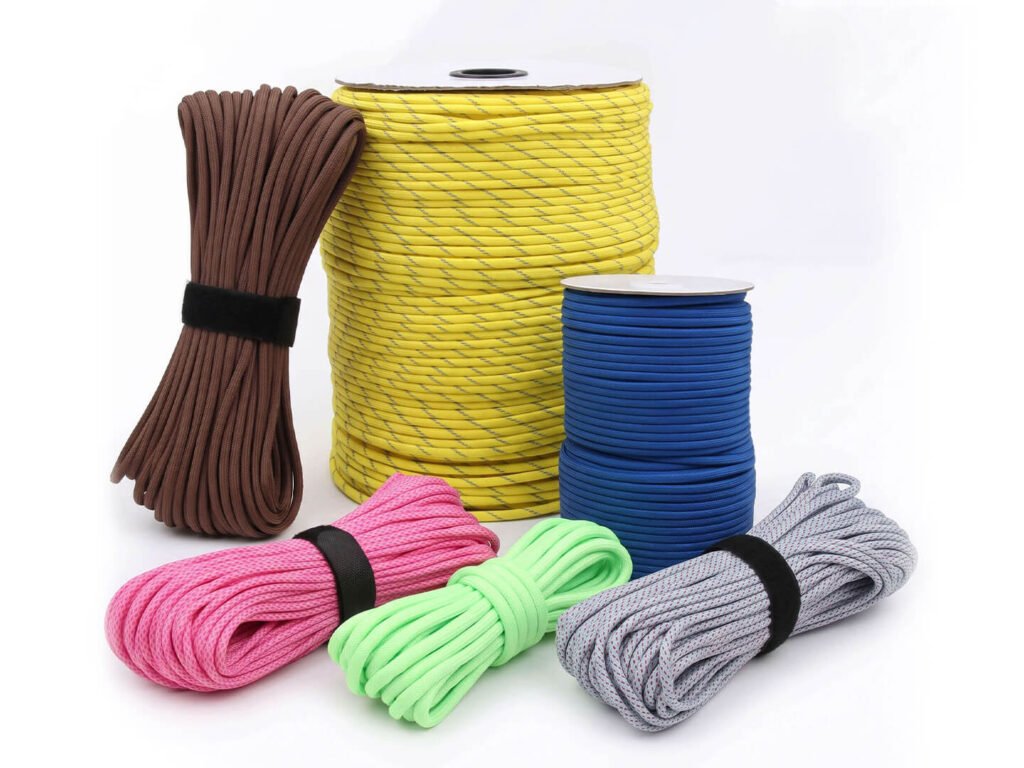
Packaging is the last customization dimension and, for retail buyers, one of the most commercially important. A rope that is packed badly costs more to ship and sells less effectively. Four formats cover most requirements.
A bundle is a straightforward bulk format — lengths gathered and secured together. It is efficient for shipping and handling, and it suits industrial, trade, and bulk-consumer channels where the product is not displayed individually.
A hank is a coiled, looped format, traditionally used for natural-fibre and general-purpose rope. It presents well in agricultural, marine, and hardware retail settings, and it is easy for a customer to handle and hang.
A spool format winds the rope onto a reel or core. It is the natural choice for continuous-length products, for cord used with dispensers, and for any application where the buyer wants to cut to length themselves.
Custom retail packaging is where OEM rope programmes differentiate themselves. This can include printed headers, hang tags, sleeves, branded labels, barcode and SKU labelling, and packaging sized to your planogram rather than to a generic standard.
If you are selling through retail, tell us the pack dimensions and the presentation you need at the brief stage. Packaging decisions made late in a project tend to be expensive ones.
For buyers sourcing under their own brand or for their own equipment, the process is deliberately linear. Six steps take a brief from first contact to packed, inspected goods.
We start with your brief: the application, the environment, the market, the target volumes, and any constraints you already know about. This is where the eight customization dimensions get mapped out. Nothing is quoted seriously until this step is complete.
From the requirement review, we propose a material direction — or a shortlist of two, where the application genuinely supports more than one. This is a technical recommendation, not a sales pitch: if polyester is the wrong answer for your application, we will say so at this stage rather than later.
The specification locks down the full build: material, construction, diameter, colour, cut length, end finishing, hardware (if any), packaging format, and any testing requirement tied to the end use. This document is the reference point for everything that follows.
A sample is produced against the specification so you can evaluate the physical product — hand feel, appearance, colour, finishing, and packing. Sample development is iterative where it needs to be, and the timeline is confirmed per project rather than assumed.
Production runs against the approved specification in our own factory in Jiangmen, China. Inspection is carried out against the agreed criteria, so the goods that ship match the goods you approved.
The final step covers packing to the agreed format, labelling, and preparation for shipment. Getting this right matters as much as getting the rope right — a correct product in the wrong packing still creates problems at the receiving end.
Because we own the factory, the specification does not get reinterpreted by an intermediary between approval and production. Material, construction, diameter, colour, cut length, finishing, and packaging stay under one roof — which is the main reason buyers move from trading-company sourcing to a custom rope manufacturer with direct production control.
Q: What can be customised on a rope order?
A: Material, construction, diameter, colour, length, rope-end finishing, packaging, and application-related testing. Baiyuheng works across polyester, polypropylene, nylon, and cotton in five braid constructions.
Q: What materials and diameters do you offer?
A: Polyester (2-5mm), and polypropylene, nylon, and cotton (3-10mm), each in hollow, solid, diamond, double, and flat braid.
Q: How does the OEM process work?
A: It follows six steps: requirement review, material direction, specification, sample development, production & inspection, and packaging coordination. Send your specs for a quote to begin.
Q: What packaging options are available?
A: Bundle, hank, spool, and custom/retail packaging, evaluated against your order and display requirements.
The right custom rope supplier does not simply take an order. It asks what the rope has to do, recommends the material and construction that suit it, tells you honestly where the volume thresholds sit, and then holds the specification steady from sample through to packed shipment.
That is the model we work to at BYH Rope. With our own factory in Jiangmen, China, we handle custom rope manufacturing across polyester, polypropylene, nylon, and cotton — five braid constructions plus twisted polypropylene options, defined diameter ranges, stock and custom colour programmes, cut lengths with sealed ends, rope-end hardware, and packaging built around your channel.
If you are planning a rope customization project — whether it is a single SKU or a multi-colour range — the fastest way to move forward is to send your specifications. Include the application, the dimensions, the finishing, the packaging, and your expected quantities, and we will respond with a clear route to production and a quote based on your actual brief.
Send your specs to our custom rope & OEM team and we will take it from there.