Request a Quote
Send your application, material or reference sample, diameter, length, color, quantity and packaging requirements. We reply within 12 hours.

CUSTOM MANUFACTURING
Baiyuheng is a custom rope manufacturer in Jiangmen, China, working with four materials: polyester, polypropylene, nylon and cotton. Define the braid, diameter, color, length, finishing, packaging and application-related testing requirements before sampling and quotation.
Share where the rope will be used, the handling or performance requirement, preferred material and forecast quantity.
Align the working details before sampling and production.
MATERIAL
Compare four material families before refining construction, dimensions and finishing. Read the polyester rope, nylon rope and polypropylene rope options, or describe your cotton rope requirement.
Low stretch, abrasion resistance and stable outdoor handling for specification-led programs.
Low density and floating performance for utility, marine and cost-sensitive applications.
High strength, elasticity and abrasion resistance where controlled stretch is useful.
A soft, natural-fiber direction for handling, decorative and product-contact requirements.
CONSTRUCTION
Five braid constructions are available across all four materials: hollow, solid, diamond, double and flat braid. Hollow braid has no separate core; the four cards below describe the other construction directions. Polypropylene also supports floating twisted and 3-strand twisted options.
A smooth, round cord direction with a firm, compact braided body.
A defined braided pattern direction for flexible, general-purpose rope programs.
A braided cover over a braided core for a structured, balanced construction.
A low-profile flat direction for straps, trims and constrained assemblies.
DIAMETER
Use these current manufacturing ranges as the starting point for specification review.
Available diameter range: 2–5 mm.
Available diameter range: 3–10 mm.
Available diameter range: 3–10 mm.
Available diameter range: 3–10 mm.
COLOR
Color route and MOQ vary by fiber and dyeing method. Final color is confirmed against the approved requirement.
Closest stock-color route: approximately 80% color match, MOQ 1,000 m per color. Custom-dyed route: over 90% similarity, MOQ 3,000 m per color.
Choose from 300+ color options. MOQ starts at 1,000 m per color.
Custom colors are available. MOQ starts at 3,000 m per color.
Natural or off-white is the standard starting point. Dyed colors and MOQ are confirmed by yarn lot, construction and order requirement.
LENGTH
Coordinate finished length and end treatment as one production specification.
Specify the finished length required for the product or assembly. Synthetic rope can be hot-cut so the end is sealed and resists fraying.
Send a reference photo or sample showing the required end finish. Agree the finished length and appearance before sample development.
FINISHING
Review the component, fixing method and finished assembly before production.
When the product requires a fixed end component—such as a metal hook, buckle or other confirmed hardware—Baiyuheng can review and coordinate the attachment method.
Provide the hardware or reference sample, fixing method and finished length so the assembly can be reviewed before quotation.
PACKING
Choose a packing direction that supports handling, assembly, distribution or retail presentation.
A compact grouped format for bulk handling and downstream assembly.
A looped presentation for organized handling, display or further processing.
A controlled feed format for longer lengths and production-line use.
Customer-specific labels, presentation and outer packing can be reviewed against the order requirement.
DEVELOPMENT WORKFLOW
Keep commercial, technical and packaging decisions visible at each development stage.
Clarify the application, known parameters and commercial context.
Match material and construction options to the use requirement.
Confirm dimensions, color, length, finishing, packaging and checks.
Prepare and review the agreed sample direction before production.
Build to the confirmed specification and apply the defined checks.
Verify labeling, packaging and shipment details against the program.
Material, construction, diameter, color, length, finishing, packaging and application-related testing requirements can be reviewed against your product brief.
Polyester is available in 2–5 mm; polypropylene, nylon and cotton in 3–10 mm. All four materials support hollow, solid, diamond, double and flat braid. Floating twisted and 3-strand twisted options are additionally confirmed for polypropylene.
Polyester stock colors start at 1,000 m per color and custom dyeing at 3,000 m per color. Polypropylene starts at 1,000 m per color, and nylon at 3,000 m per color. Cotton dyed-color MOQ is confirmed by yarn lot, construction and order requirements.
Send the application, material or reference sample, construction, diameter, length, color, estimated quantity, finishing, packaging and testing requirements. Sample timing, production schedule, shipping inclusion and final price are confirmed for your project.
MANUFACTURING & QUALITY CONTROL
Agree the inspection focus before production so the finished rope can be reviewed against the intended requirement.
For shared specification terms, refer to the Cordage Institute’s fiber-rope terminology. Agree any required tests and acceptance criteria for the actual product.
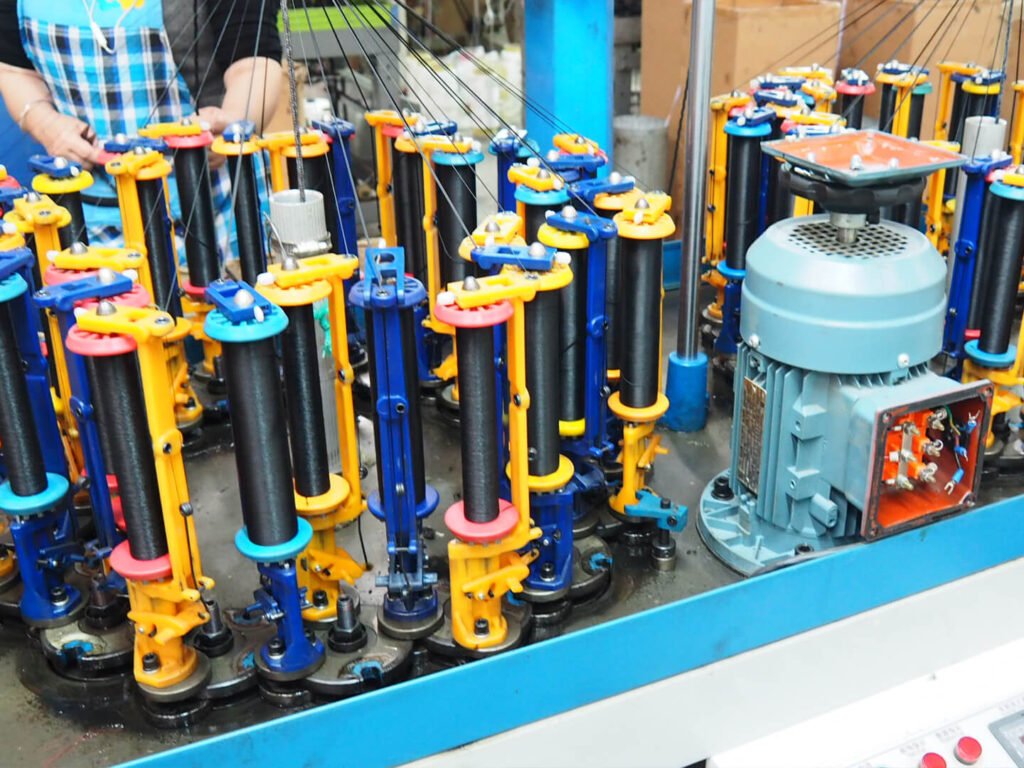
Define what needs to be verified before the production run is accepted.
Connect the inspection plan to how the rope will be used and delivered.
BUYER READY
Give both sides the information needed to discuss feasibility, sampling and a specification-based quotation.
A specification-first route for buyers who need rope to fit a product, range or supply program.
Share the facts already known; unknown fields can be reviewed during specification development.
START YOUR SPECIFICATION
Send the use case and known parameters. Baiyuheng will review the requirement and coordinate the next specification step.
Use the contact page to share the application, known dimensions, quantity direction and packaging requirements.
WhatsApp us